

The Fig Tree Above the Whirlpool
Why Homer chose a wild fig to save Odysseus — and why that choice still matters

All his men were dead, hundreds of them. Some were slain in combat, others eaten alive by a monstrous cyclops, speared like fish by giants, or drowned at sea in the storm of a god’s wrath. Now Odysseus was alone and adrift in a violent sea, clinging to a makeshift raft fashioned from the wreckage of his sunken ship. Waves carried him into a narrow channel hemmed by sheer cliffs. Peril surrounded him.
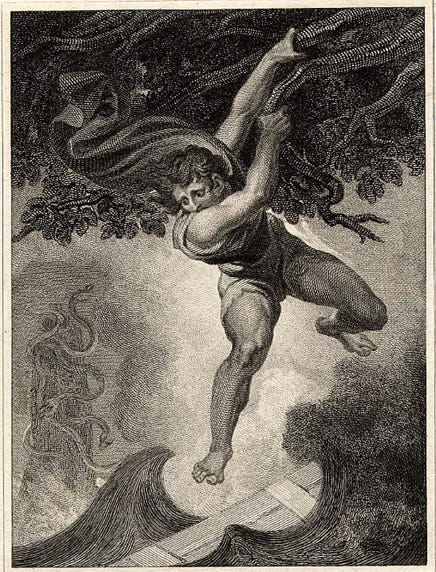
In a cave on one side lurked Scylla, a fearsome sea monster with six heads on long necks. Only recently, her powerful jaws had snatched six of Odysseus’s companions and devoured them alive. On the other side — closer, and even more terrifying — dwelt Charybdis, an unseen horror beneath the waves. Three times each day, its vast maw swallowed the sea, creating a roaring whirlpool before spewing the water back out again. Leaning out over the maelstrom grew a wild fig tree, its roots gripping a bare, wave-battered rock.
This scene, first narrated nearly three millennia ago, marks the lowest point of Greek poet Homer’s Odyssey.
For the hero, all hope seemed lost. But as Charybdis sucked in and swallowed his crude raft, Odysseus leapt upward and seized hold of the fig tree’s trunk. Homer says he clung to it “like a bat” as the sea churned beneath him. When the whirlpool spat out his raft, Odysseus dropped into the water, recovered it, and paddled desperately away towards safety.
The fig tree appears for only a few lines in Homer’s epic. Yet without it, The Odyssey would end here. The greatest journey in Western literature, and its archetypal hero, are saved by a tree.

Why a fig?
Homer could have chosen any tree. Why did he choose a wild fig? Catalin Anghelina of the Department of History, Political Science, Languages and Cultures at Otterbein University argues that this choice was deliberate. Unlike the olive tree — which repeatedly symbolizes the goddess Athena’s protective presence throughout The Odyssey — the fig tree appears precisely at the moment when the goddess cannot intervene.
Odysseus is being punished directly by the supreme deity Zeus, and even Athena is powerless to shield him. The fig tree therefore marks the one moment in the story when Odysseus must survive without divine assistance.
Han Tran, a senior lecturer in classics at the University of Miami, reaches a complementary conclusion. “This fig tree belongs to a natural world over which mortals are not masters,” she writes. Thriving on “the barren surface of a salt-encrusted rock”, where it is lashed by storms, the tree becomes an expression of nature’s irrepressible vitality. Tran likens it to Gaia, the primordial force of life itself, endlessly creating even under the harshest conditions.
Roots of resilience
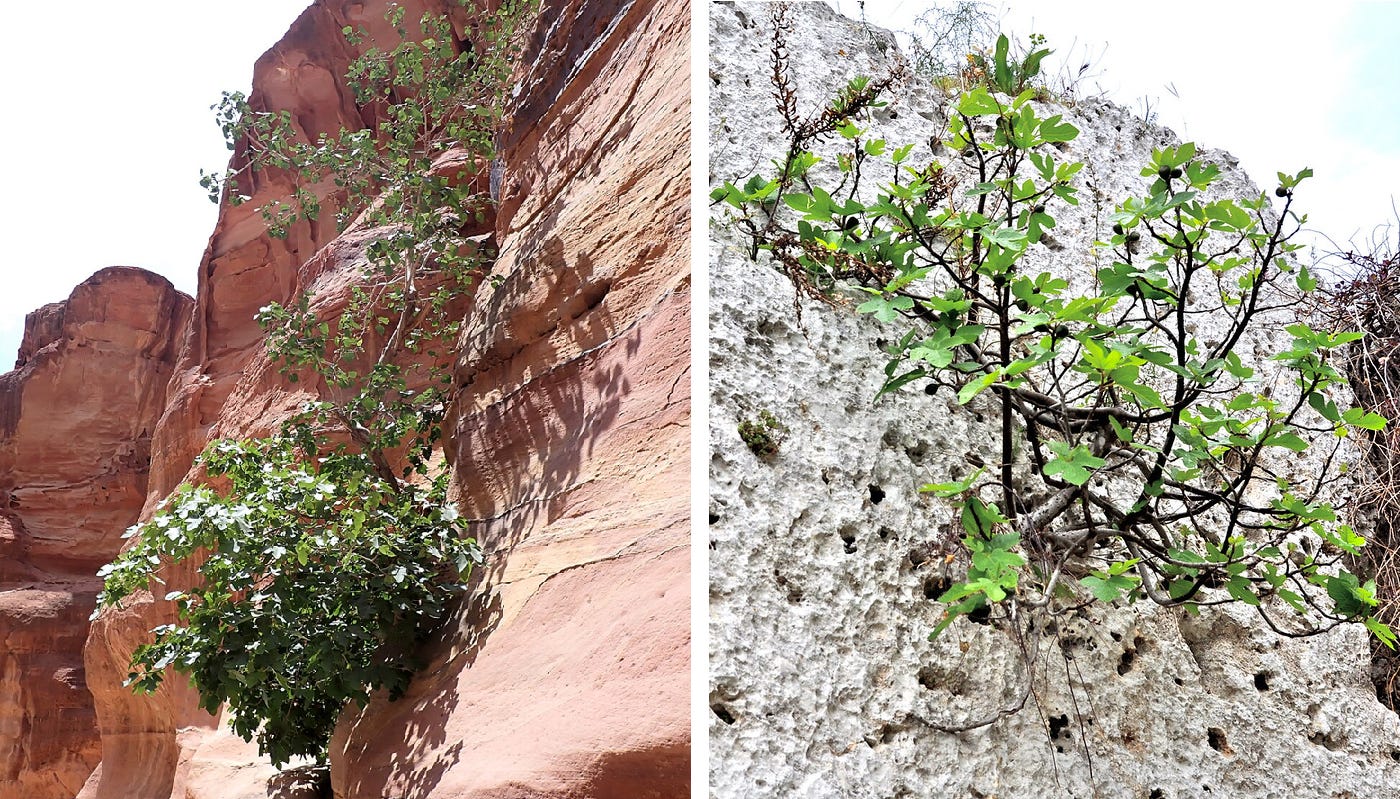
The fig in Homer’s story belongs to a lineage of trees whose extraordinary ability to endure hostile environments has shaped landscapes for millions of years. The tree would have been a Ficus carica, a species widely domesticated but also growing wild throughout the eastern Mediterranean. Unlike most fruit trees, fig trees readily colonize cliffs, rocky slopes and the walls of abandoned buildings.
Their seeds germinate in tiny cracks where almost nothing else can grow. Their roots penetrate deep in rock, anchoring the tree while gradually widening the fissures. They are also among the fruit trees most tolerant of saline conditions. Tran describes Homer’s sea-sprayed tree as improbable, but such a tree is by no means impossible.
Ficus carica’s tropical relatives are equally adept at thriving in extreme conditions. In Indonesia, fig trees soon germinated in the bare lava left behind by the eruption of Krakatau in 1883. Fig roots can also reach astonishing depths in search of water. In South Africa, the roots of a Ficus natalensis tree hold a Guinness World Record for penetrating 120 metres below ground.

More than a symbol
Ancient audiences would have recognized the symbolic significance of the tree. Today, the scene invites another reading as well.
Homer was not writing about climate change. But his image of a lone survivor clinging to a tree while the forces of nature rage around him feels strikingly contemporary. As climate change threatens more communities with floods, fires, storms and landslides, the question of what allows people — and landscapes — to endure becomes ever more urgent.
The fig tree reminds us that, even in times of crisis, nature can sometimes provide the means of survival. But what Homer could never have imagined is just how remarkable fig trees really are.
What Homer couldn’t have known
Fig trees evolved when giant dinosaurs still walked the Earth. Over the tens of millions of years since then, they have diversified into more than 900 species and have spread across a great swathe of the planet. In tropical and subtropical regions, they are keystone species, producing figs year-round and sustaining wildlife through periods of fruit scarcity. No other trees feed so many species, at so many times of year.
Across the world, people are increasingly turning to fig trees when landscapes are damaged or unstable. Their unusual combination of deep roots, drought tolerance, rapid growth and ability to attract wildlife make them pioneers of ecological recovery.
Scientists in Australia and Thailand have used fig trees to accelerate forest regeneration by attracting seed-dispersing birds and mammals. In northeast India, communities have learned to train the roots of Ficus elastica trees into meshes that stabilise steep land prone to landslides and even build living bridges that connect villages in remote areas. In the drylands of Ethiopia, Ficus thonningii trees boost the resilience of farmers during drought conditions, providing shade for crops and fodder for livestock that is more nutritious than commercial feeds. And in Malaysian Borneo, projects are planting fig trees on old oil palms to connect patches of forest and boost food supplies for endangered wildlife.
In the face of the challenges of climate change, The Odyssey’s fig tree is a reminder that we cannot rely on divine intervention, that solving the problem is ultimately our responsibility — but also that nature can be one of our greatest allies.
Homeward bound
The hero’s homecoming — or nostos — is one of the great themes of The Odyssey. It means more than Odysseus simply returning to his home on the island of Ithaca. It is about recovering identity, family, belonging and one’s proper place in the world after prolonged hardship.
Our home is not merely the place where we happen to live, but the living Earth itself. The word “ecology” derives from the Greek oikos — meaning home. If our own nostos is still ahead of us, then it is not a journey back to a single place. It is the work of restoring the living systems that make every home possible, and repairing the damaged relationship between humanity and the rest of life on Earth.
The fig tree Homer placed above the whirlpool tells us that even his greatest hero depended for survival on the living world. Odysseus would never have reached his home without the tree that was there when he needed it.
Our own journey home will require us to both protect existing trees and plant new ones where they are needed most. Whether there will still be such trees to cling to will depend on the choices we make long before we reach our own whirlpools.
Postscript 1: Scylla and Charybdis were born of ancient imagination, but today both names belong to real sea creatures. In 1833, zoologist Wilhem de Haan named two groups of Indo-Pacific crabs Scylla and Charybdis. Some are invasive species. Charybdis longicollis has reached the Mediterranean Sea, where it is a predator of local molluscs, fish and crustaceans. Research published in 2025 showed that climate change will greatly expand the area of suitable habitat for this species — including waters around Ithaca, the island Odysseus spent a decade trying to reach.
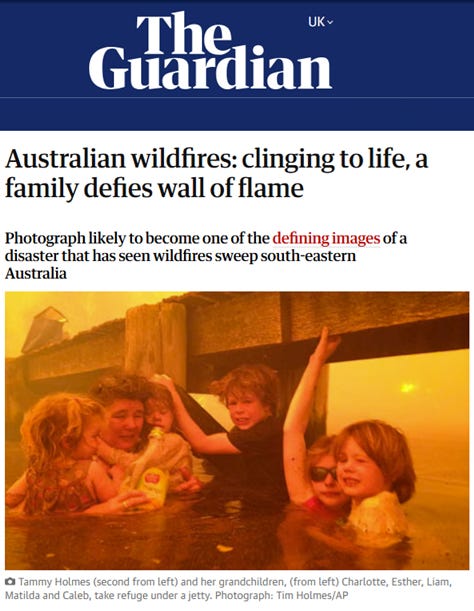
Postscript 2: Being caught ‘between Scylla and Charybdis’ entered the English language as a precursor to later phrases featuring ‘a rock and a hard place’, or ‘the devil and the deep blue sea’ — meaning the state in which every option is dire. The image it brings to my mind is that of Tammy Holmes and her five grandchildren, who fled into the sea to escape a wall of wildfire that engulfed the town of Dunally in Tasmania, Australia in 2013. Such are the decisions we will increasingly face until we get a grip on climate change and the carbon emissions that cause it — to run from flames and risk drowning in rising seas.
Postscript 3: I saw Christopher Nolan’s movie The Odyssey the day after publishing this and was surprised that he did not include the scene I describe here, which among the story’s most pivotal moments — the point where all is lost and death seems certain for Odysseus. It makes me all the more pleased to have told the story here.
Thanks for reading. For more astounding stories about the ecological and cultural importance of fig trees, see the Planet Ficus archive. To support my work please consider subscribing or sharing this post.
Your expertise in Ficus truly has no bounds, and it's inspiring the way you link this story to the literal threat of climate change. I'm forced to grow figs only seasonally, but as they winter in a safer storage your stories draw me more and more into the wonder of this plant. I can see why it's so meaningful to you.
This is brilliant, Mike. And perfectly timed for the new Odyssey film. I did not remember the tree in that scene, and never would have guessed it was a fig tree.