

Where Thousands Share Wishes With a Fig Tree
How hopes cast into branches have reshaped a village

As plastic trees go, the fake strangler fig in Fong Ma Po village in Hong Kong’s Lam Tsuen valley is a pretty good replica. And very popular. During the Lunar New Year festivities, people come in their tens of thousands — from across Hong Kong and beyond — hoping it will fulfil their wishes.
The tree stands beside a temple built more than 250 years ago to honour Tin Hau, the sea goddess who protects sailors and fishermen. Long ago, villagers believed that a camphor tree on the site could make wishes come true. In time, the camphor tree died but the belief lived on as people’s hopes migrated to the large fig trees (Ficus microcarpa) growing nearby.
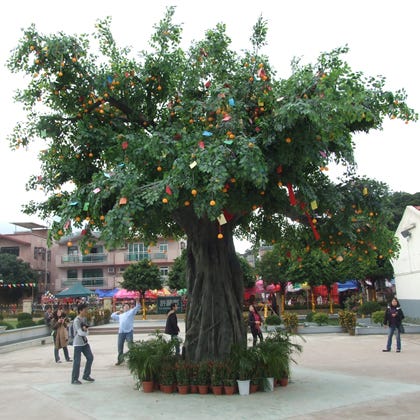
Wish-granting fig trees are not unique to Hong Kong. They appear in stories from places as diverse as Brazil, Sudan and India —part of a wider constellation of spiritual, religious and cosmological traditions surrounding fig trees across the planet. In Lam Tsuen, the belief took a distinct form.
To make a wish, fishermen used to write their desires on paper, tie the paper to a stone and throw it into one of the tree’s branches. If the bundle remained suspended in the canopy, they believed the wish would come true. If it fell, the tree had rejected it. The higher the hurled wish landed, the better its chance of coming true.
In the 1990s, as television soap operas popularized the tradition across Hong Kong, stones were replaced by oranges — both safer and symbolically associated with prosperity. By the early 2000s, the old wishing tree had become one of Hong Kong’s most popular Lunar New Year attractions.
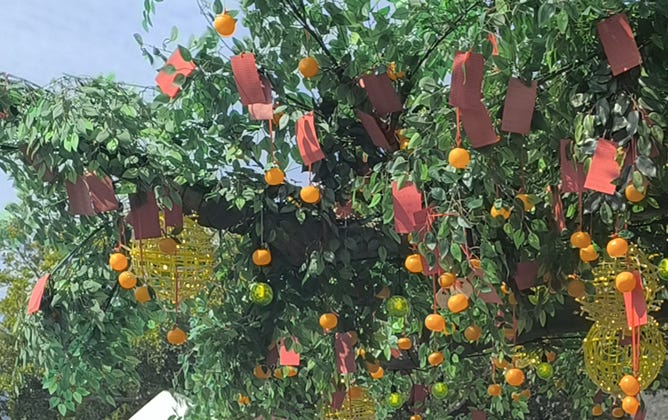
Each winter, the tree accumulated thousands of orange-weighted wishes. In February 2005, the burden became too much. A large branch snapped and crashed to the ground, injuring a 62-year-old man and a four-year-old boy who had been throwing oranges into the tree.
After the incident, authorities intervened. Throwing oranges at the fig tree was forbidden. Poles were put in place to support its branches. In 2009, the artificial fig tree was installed to replace it as the focus of wish-making.
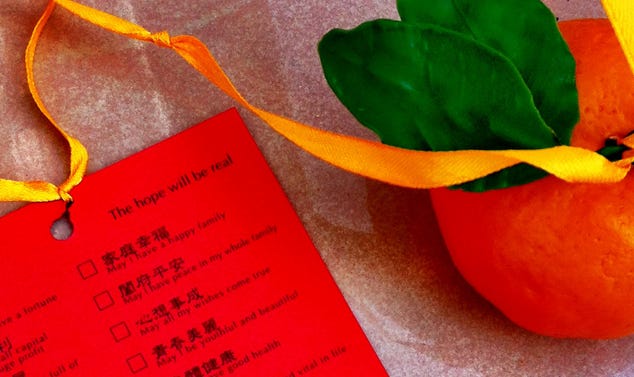
Today, visitors throw plastic oranges at the replica tree. Before launching them skyward, they can tick boxes on an attached list of common wishes — success in business and exams, safe travel, wealth, heath, happiness, love and peace.
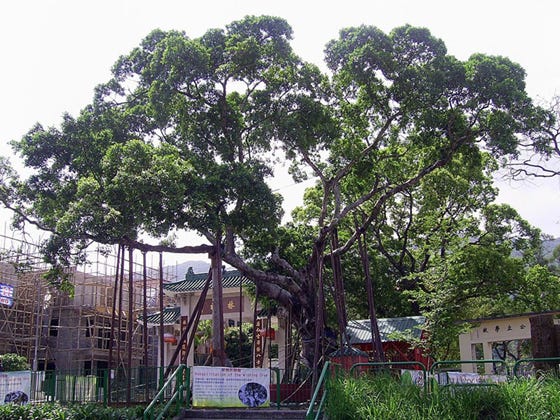
The real fig tree is still there, aided by its supports. Its canopy is lighter now and some dead branches have been removed. No-one can be sure how old it is or how long it has left to live. For now, it watches over its replacement — the artificial tree installed to absorb the annual storm of aspirations.
It is a joyous scene. People of all ages come to write down their hopes for the future and cast them at the wish-fulfilling tree. Music and incense fill the air. Stalls offer games and local delicacies.
What began as fishermen’s pleas for luck at sea has become a major cultural attraction, boosting the local economy and drawing as many as 60,000 visitors on the busiest day of the Lunar New Year holiday. If those original fishermen ever wished for prosperity for their families, then their hopes have, in a sense, come true. Their descendants have built a thriving celebration rooted in that old belief.
Thank you for reading. I’m grateful you’re here under the canopy of Planet Ficus. Each story is a reminder that we are all connected — to each other, to other species and to the trees themselves. If you know someone who would enjoy these connections, please pass this newsletter along or invite them to subscribe.


.jpg)

This story is probably the strangest one about a fig tree. I don't suppose it's anymore bizarre than the US custom of the "wishing well", theoretically an old fashioned well where water is retrieved by using a bucket with a rope. Modern wishing wells don't have water, or ropes and buckets for that matter. Close enough to persuade people to throw in loose change and make a wish.